
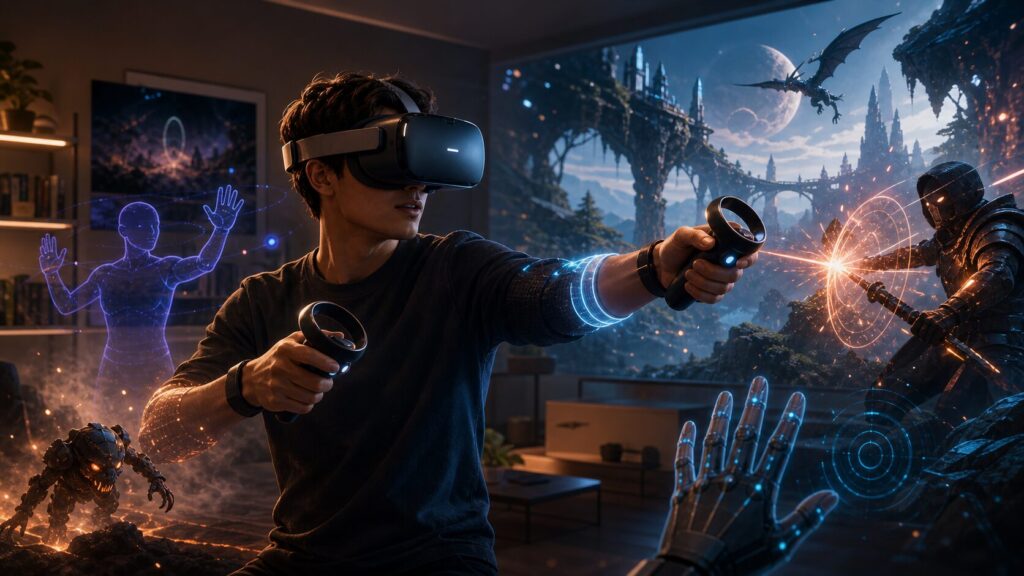
Illustration of a player using a generic VR headset and controllers in an immersive gaming room
Editor note: VR hardware changes quickly. This guide focuses on durable concepts and buying factors, not a ranking of every headset.
Who this guide is for: Gamers, parents, students, and technology readers who want to understand where virtual reality gaming is going and what features actually matter.
Editorial transparency: Prepared by The Infosiast and last reviewed on June 5, 2026. This article was rewritten to replace thin generic copy with a practical, source-backed guide.
Virtual reality gaming has moved from novelty demos to a real gaming category. Modern VR headsets can track head movement, controllers, hands, room position, and sometimes the physical environment around the player. The best experiences no longer feel like “a screen strapped to your face.” They feel like spatial games built around presence, movement, and interaction.
That does not mean VR is perfect. Comfort, price, game libraries, motion sickness, battery life, setup friction, and space requirements still matter. The smartest way to understand VR gaming is to look at the technologies improving the experience and the limits that still shape adoption.
What makes VR gaming different?
Traditional games put you in front of a screen. VR places the screen around you and tracks where you look and move. That changes the design of the game. A doorway can feel life-size. A puzzle can sit on a virtual table. A rhythm game can use your whole body. A horror game can feel more intense because you cannot simply look away from the world by glancing outside the monitor.
The main ingredient is presence: the feeling that your body is inside the experience. Presence comes from low-latency tracking, stable frame rates, accurate scale, responsive controls, spatial audio, and comfortable headset design.
Headset improvements that matter
- Display clarity: Higher resolution and better lenses reduce blur and make text easier to read.
- Tracking: Inside-out tracking lets many headsets understand position without external base stations.
- Mixed reality: Passthrough cameras can blend virtual objects with the real room.
- Wireless play: Standalone headsets reduce cables and setup friction.
- Comfort: Weight balance, straps, heat, and lens adjustment can decide whether a headset is used daily or left in a drawer.
- Controllers and hands: Motion controllers remain important, while hand tracking is improving for menus, social apps, and casual interactions.
Mixed reality is changing VR design
Mixed reality uses cameras and sensors to show parts of the physical world while placing digital objects into it. For gaming, this means a living room can become a play space. A board game can appear on a real table. A fitness game can keep the player aware of walls and furniture.
This matters because full isolation is not always practical. Mixed reality can make VR more comfortable for new users and safer for room-scale movement. It also opens design space for games that interact with your real environment instead of replacing it completely.
Haptics and interaction
Haptic feedback gives physical sensation through vibration or force cues. In VR, haptics can make a bowstring, sword hit, engine rumble, or rhythm beat feel more convincing. Most consumer haptics are still limited, but even simple feedback can improve timing and immersion.
Interaction design matters more in VR than in flat-screen games. Picking up an object, reloading a weapon, climbing a wall, or throwing a ball must feel natural enough to avoid frustration. Good VR games do not simply copy controller inputs from traditional games. They design around spatial movement.
Comfort and motion sickness
VR motion sickness can happen when the eyes perceive movement that the body does not feel. Developers reduce this with teleport movement, snap turning, stable horizons, high frame rates, careful camera control, and comfort settings. Players can also build tolerance gradually.
If you are new to VR, start with short sessions and comfortable games. Stop if you feel nausea, headache, dizziness, eye strain, or disorientation. VR should be fun, not something you push through like a test of toughness.
Social VR and multiplayer
Social VR can make multiplayer feel more personal because players share a sense of space. Voice, gestures, avatars, and proximity can make cooperation and competition feel different from ordinary online play. This is powerful for games, events, fitness, learning, and virtual meetups.
It also creates moderation and safety challenges. Harassment in VR can feel more intense because of embodiment and proximity. Strong privacy settings, reporting tools, personal boundaries, and age-appropriate spaces are important.
What to consider before buying a VR headset
- Does the game library include titles you actually want?
- Do you need a gaming PC or console, or is the headset standalone?
- Is there enough safe play space?
- Can the headset adjust for your glasses or lens needs?
- How comfortable is it for sessions longer than 20 minutes?
- What parental controls and privacy settings are available?
- Are replacement controllers, face pads, and straps easy to find?
The future of VR gaming
The next stage of VR gaming is likely to focus on lighter headsets, better passthrough, stronger mixed-reality games, more natural hand interaction, improved social spaces, and better content discovery. Cloud streaming and PC wireless streaming may also matter, but latency will remain a key challenge.
The winning experiences will not be the ones with the longest feature list. They will be the games that use presence for something a normal screen cannot do as well.
Standalone VR vs. PC VR vs. console VR
One of the biggest decisions is platform. Standalone VR headsets run games on the headset itself, which makes setup easier and reduces cables. PC VR can deliver higher-end graphics and simulation depth, but it usually requires a capable gaming computer and more configuration. Console VR sits between those worlds: simpler than PC VR, but tied to one console ecosystem.
There is no universal best choice. A casual player may value wireless convenience more than maximum graphics. A simulation fan may prefer PC VR for racing, flying, or mod-supported games. A family may prefer the platform with the simplest parental controls and the most comfortable setup.
Game design is the real test
Hardware gets attention, but software decides whether VR feels worth it. A strong VR game understands body movement, camera comfort, reach, scale, and pacing. A weak VR game simply places a traditional game in a headset and hopes immersion will do the work.
Good VR design often includes readable menus, seated and standing options, adjustable comfort settings, clear boundaries, and interactions that feel physical without becoming tiring. The best games respect the player’s body.
Safety and space setup
Before playing, clear the area. Remove sharp objects, fragile items, pets, cables, and furniture edges from the play space. Use the headset’s boundary system if available. Take breaks, especially when sharing the headset with new users.
For children and teenagers, check the headset maker’s age guidance, privacy settings, chat controls, purchase controls, and content ratings. VR can feel intense, so age-appropriate content matters.
What would make VR more mainstream?
VR will become easier to recommend when headsets become lighter, cheaper, clearer, more comfortable, and less socially awkward to use. Larger game libraries, better mixed-reality features, improved battery life, and stronger social safety tools will also matter.
The future of VR gaming is not only about realism. It is about making immersive play simple enough that people use it often, not only as a weekend novelty.
Related guides
Sources
Bottom line
VR gaming is strongest when it creates experiences that depend on presence, space, and movement. Better displays, tracking, mixed reality, haptics, and comfort are making that easier. But the right headset still depends on your games, space, budget, comfort, and tolerance for early technology tradeoffs.