
Educational resource: Last reviewed on September 21, 2026. Formatted according to IUPAC stereochemical terminology and standard university organic chemistry curricula.
In organic stereochemistry, racemization is the process in which an optically active substance (consisting of a pure enantiomer or an enantiomeric excess) is converted into an optically inactive racemic mixture (also called a racemate). A racemic mixture contains equal (50:50) molar quantities of the dextrorotatory (+) and levorotatory (-) enantiomers, resulting in an observed net specific rotation of zero degrees (α = 0°).
When Does Racemization Occur?
Racemization occurs whenever a chemical transformation temporarily converts a chiral tetrahedral ($sp^3$-hybridized) stereocenter into an achiral, planar, or symmetrically accessible intermediate before reconstructing the stereocenter.
1. Nucleophilic Substitution ($S_N1$ Mechanism)
The classic textbook example of racemization occurs in first-order nucleophilic substitution ($S_N1$) reactions. The process proceeds in two discrete stages:
- Ionization to Carbocation: The leaving group departs with its electron pair, leaving behind a planar, $sp^2$-hybridized trivalent carbocation with an empty unhybridized $p$-orbital perpendicular to the molecular plane.
- Front- and Back-Side Attack: Because the carbocation is symmetrical and planar, the incoming nucleophile can attack from either the front lobe or the rear lobe of the empty $p$-orbital with equal geometric probability.
Attack from the side opposite to the original leaving group produces an inverted configuration ($R rightarrow S$ or $S rightarrow R$). Attack from the same side retains the original configuration. In ideal conditions, this 50:50 competition results in complete racemization.
2. Enolization and Carbonyl Epimerization
When a chiral center is adjacent to a carbonyl group (at the α-carbon possessing an α-hydrogen), treatment with trace acid or base causes rapid tautomerization between the keto form and the planar enol or enolate intermediate. Because the enol double bond is planar, protonation from either face occurs with equal likelihood, causing gradual racemization of the α-carbon over time.
3. Free Radical Halogenation
When a reaction generates a trivalent carbon radical at a stereocenter, the intermediate adopts either a planar $sp^2$ geometry or rapidly inverts via shallow pyramidal tunneling. Subsequent halogen abstraction occurs from either face, yielding a racemic product.
$S_N1$ vs $S_N2$ Stereochemical Outcome Comparison
| Parameter | $S_N1$ Reaction | $S_N2$ Reaction |
|---|---|---|
| Intermediate | Planar $sp^2$ Carbocation | Trigonal Bipyramidal Transition State |
| Direction of Attack | Both front and rear faces | Exclusively backside (180° from leaving group) |
| Stereochemical Result | Racemization (often with slight excess inversion) | Complete Inversion of Configuration (Walden Inversion) |
| Kinetics | First order: Rate = $k[text{Substrate}]$ | Second order: Rate = $k[text{Substrate}][text{Nucleophile}]$ |
Why Do Real $S_N1$ Reactions Show Partial Inversion?
In physical laboratory settings, complete 50:50 racemization is rare. More frequently, reactions exhibit partial racemization with an excess of inversion (e.g., 70% inversion, 30% retention). This occurs because of the intimate ion pair phenomenon:
When the leaving group departs, it remains in close electrostatic proximity to the front face of the newly formed carbocation for a fraction of a picosecond before diffusing into the bulk solvent. This departing anion physically shields the front face from immediate nucleophilic approach, biasing the incoming nucleophile to attack from the unshielded backside.
Real-World Applications: Amino Acid Racemization Dating
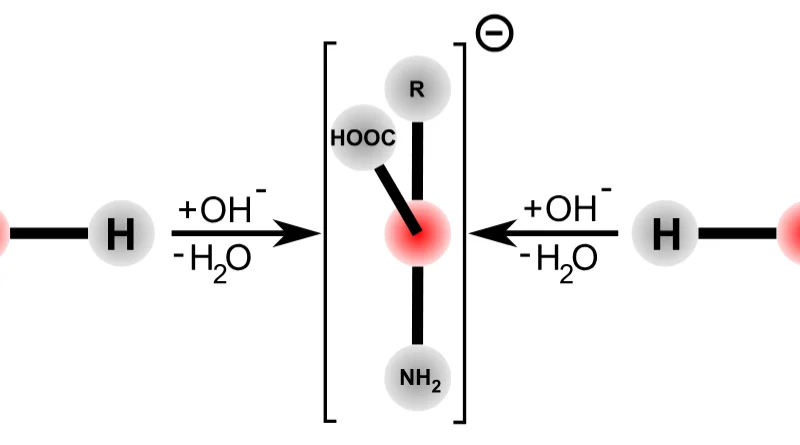
In living organisms, proteins are synthesized almost exclusively using L-enantiomer amino acids (such as L-aspartic acid). Following the death of an organism, biological enzyme repair ceases, and the L-amino acids undergo spontaneous, temperature-dependent non-enzymatic racemization into D-amino acids until reaching a 1:1 equilibrium.
In forensic anthropology, archaeology, and paleontology, measuring the ratio of D-to-L enantiomers (D/L ratio) in tooth enamel and fossil bone matrix allows scientists to determine the age of biological specimens over archaeological spans of 10,000 to 100,000+ years.
Frequently Asked Questions
What is racemization in organic chemistry?
Racemization is the process by which an optically active compound containing a single enantiomer is converted into an optically inactive racemic mixture containing equal amounts of dextrorotatory and levorotatory enantiomers.
Why does racemization occur during an SN1 reaction?
In an SN1 mechanism, the leaving group departs first, forming a planar sp2-hybridized carbocation intermediate. The incoming nucleophile has an equal probability of attacking from the front or back face, producing an equal mix of inverted and retained enantiomers.
Academic Sources & Curriculum References
- IUPAC Compendium of Chemical Terminology (Gold Book): Definition of Racemization
- Royal Society of Chemistry: Advanced Stereochemistry and Ion Pair Kinetics