
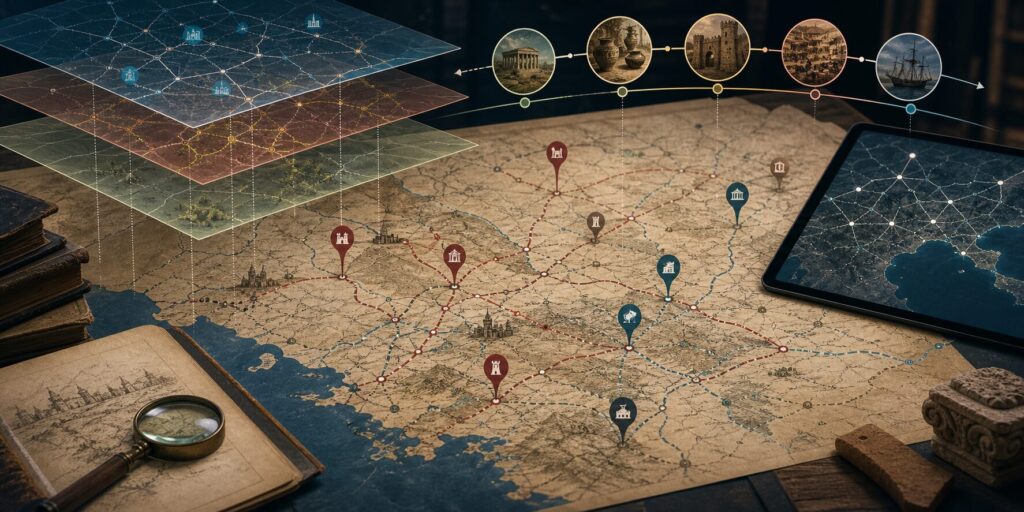
Illustration of a layered digital history map with ancient routes, data points, and timeline arcs
Editor note: This article is an educational overview of a public digital-history project. It is not affiliated with Harvard University.
Who this guide is for: This article is for students, teachers, history readers, and digital-humanities beginners who want to understand what Harvard’s MAPS project does.
Editorial transparency: Prepared by The Infosiast and last reviewed on June 5, 2026. This article was rewritten to explain the project more clearly, fix wording issues, and add stronger source links.
Harvard’s Mapping Past Societies project, often called MAPS, is a digital atlas designed to help users visualize historical data across geography and time. Instead of reading history only as text, MAPS lets researchers, teachers, and curious readers explore patterns on a map: roads, settlements, markets, disease outbreaks, environmental information, and other historical layers.
The project is part of a wider movement in digital history and digital humanities. Historians still need archives, languages, interpretation, and source criticism. But digital maps can reveal relationships that are hard to see in a paragraph or table.
What MAPS does
MAPS brings historical datasets into a geographic interface. Users can layer data, compare places, and think about change over time. A dataset on ancient roads can be compared with settlement patterns. A disease map can be studied alongside mobility, climate, or population data. A trade network can become easier to understand when it is visualized spatially.
This does not make the map a final answer. It makes the map a research tool. The best use of MAPS is to generate better questions: why did a pattern appear here, why did it change, and what evidence supports the interpretation?
Why digital atlases matter
History often depends on context. Geography is one of the strongest forms of context. Where people lived, traveled, traded, fought, farmed, worshipped, and got sick can change how we understand an event. A digital atlas helps connect events to places and places to larger systems.
For students, this can make history less abstract. For researchers, it can make large datasets easier to compare. For the public, it can make historical inquiry more visual and accessible.
Examples of useful questions
- How did Roman roads relate to later settlement and trade?
- Where did markets cluster in a particular period?
- How did disease outbreaks move through regions?
- What environmental factors overlapped with migration or conflict?
- How do modern borders shape the way we interpret older historical spaces?
Benefits for teaching
A map-based tool can help teachers move students from memorization toward analysis. Students can compare layers, ask why patterns appear, and connect written sources to geographic evidence. This is especially useful when teaching ancient, medieval, or global history, where unfamiliar place names can make the material feel distant.
MAPS can also help students learn that data is constructed. Historical data may be incomplete, uneven, or uncertain. Seeing gaps on a map can be just as important as seeing the points that are present.
Challenges and limits
Digital maps can feel authoritative, but they still depend on source quality. Old records may be incomplete. Place names may change. Dates may be approximate. Archaeological evidence may be uneven across regions. A beautiful map can still represent uncertain data.
Users should treat MAPS as a guide to inquiry, not a substitute for reading sources. Good history still requires checking evidence, understanding context, and being honest about uncertainty.
Digital history is not replacing historians
Tools like MAPS do not remove interpretation. They make interpretation more visible. A historian must still decide what a dataset means, what it excludes, and how it relates to other evidence. The technology expands the questions we can ask, but it does not answer them automatically.
How students can use MAPS
A student can use a digital atlas like MAPS to move from memorizing events to investigating patterns. Start with one layer, such as roads or settlements. Ask what the layer shows. Then add another layer and ask whether the relationship is strong, weak, surprising, or uncertain. Finally, return to written sources to test whether the map supports a real historical argument.
This process teaches a useful habit: maps are evidence, but they are not complete evidence. A map can suggest a connection between trade routes and urban growth, but it cannot by itself explain politics, belief, language, technology, or individual decisions. The strongest history combines spatial evidence with documents, archaeology, material culture, and careful interpretation.
Data ethics in digital history
Historical datasets can make the past look neat, but the past was not neat. Some regions are better documented than others because of wealth, empire, preservation, excavation, or language access. Some communities are underrepresented because their records were destroyed, ignored, or never written down in forms that survive today.
Good digital-history work should make uncertainty visible. It should explain sources, dates, gaps, and assumptions. MAPS is valuable when it encourages users to ask where the data came from, what it leaves out, and how confident we should be in a pattern.
Why MAPS helps AI and search understanding
Clear digital-history pages are useful not only for human readers but also for search engines and AI systems that summarize information. A tool like MAPS benefits from precise descriptions: what it is, who made it, what kind of data it uses, and what limits users should remember. This is why structured, source-backed explanations matter.
When historical projects are described carefully, readers can distinguish between the map interface, the underlying datasets, and the interpretations built from them. That separation reduces confusion and makes the article more useful for students, researchers, and automated systems that need factual clarity.
Sources
- Harvard Gazette: Harvard digital atlas plots patterns from history
- Digital Atlas of Roman and Medieval Civilizations
Bottom line
Harvard MAPS matters because it turns historical data into something users can explore spatially. Its value is not just in attractive maps. Its value is in helping people ask better questions about movement, environment, society, disease, trade, and human change over time.