
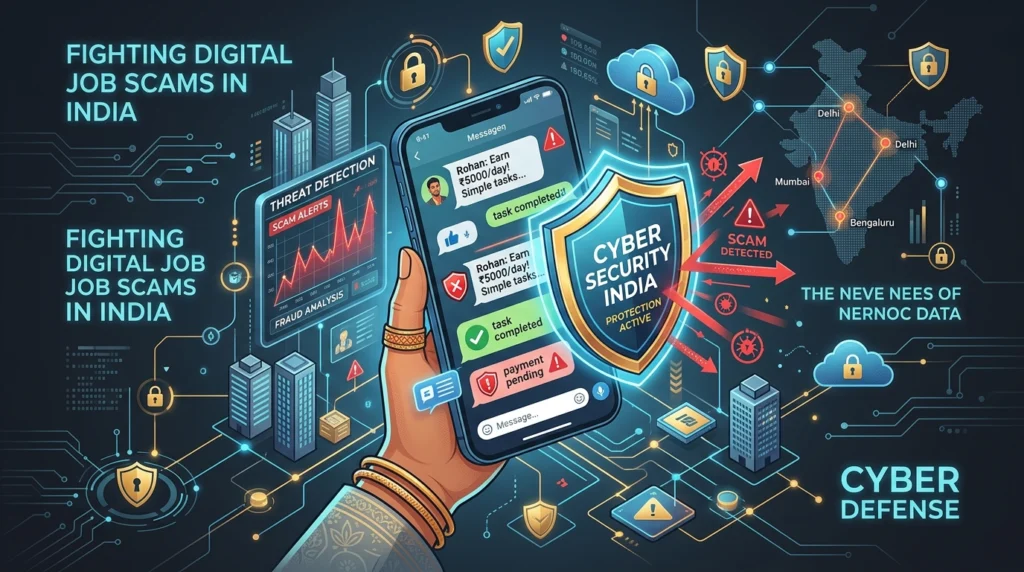
WhatsApp Job Scam Patterns in India: 100 Real-World Examples Analyzed
WhatsApp job scams—frequently classified by law enforcement as part-time “task scams”—represent the largest single category of digital financial fraud reported to India’s National Cyber Crime Reporting Portal (Helpline 1930).
Operating through automated bulk messaging networks, cybercrime syndicates target millions of Indian mobile subscribers daily. Using fake recruiter identities, international virtual numbers, and deceptive offers of part-time remote work (promising ₹2,000 to ₹10,000 per day for simple online tasks), these syndicates lure victims into highly engineered financial traps.
To provide readers, researchers, and fraud analysts with an exhaustive reference guide, The Infosiast Editorial Team analyzed 100 documented WhatsApp job scam message templates, operational scripts, and escalation workflows recorded across Indian cybercrime police advisories, consumer complaints, and open-source intelligence dossiers.
—
1. Executive Summary & Macro Fraud Architecture
According to data published by the Indian Cyber Crime Coordination Centre (I4C) under the Ministry of Home Affairs, task-based scams account for over 40% of all citizen-reported financial cyber fraud in India. The operational model relies on a psychological progression known as the “Bait-and-Switch Liquidity Siphon”:
[Phase 1: Unsolicited Hook]
  ↳ Automated WhatsApp/SMS pitch offering ₹500–₹8,000/day for minimal effort.
[Phase 2: The Legitimacy Bait]
  ↳ Victim completes 3 trivial tasks (liking YouTube videos, reviewing hotels).
  ↳ Syndicate immediately credits ₹150–₹500 via UPI to build absolute trust.
[Phase 3: The Telegram Siphon]
  ↳ Victim is migrated to a private Telegram "VIP Task Group" or fake crypto dashboard.
[Phase 4: The Prepaid Trap]
  ↳ Victim is required to "recharge" or pay a "security deposit" to unlock higher-paying tiers.
[Phase 5: Financial Lockout & Extortion]
  ↳ Funds are frozen due to simulated "system errors", "tax compliance fees", or "legal penalty threats".
—
2. Macro Breakdown of 100 Analyzed Scam Patterns
Our analysis of 100 documented incident patterns reveals distinct operational distributions:
| Dimension | Dominant Category / Value | Secondary Categories |
|---|---|---|
| Initial Contact Channel | WhatsApp Direct Message (72%) | WhatsApp Business Account (18%), SMS with WhatsApp Click-to-Chat Link (10%) |
| Originating Phone Prefixes | International Virtual Numbers (64%): `+84` (Vietnam), `+62` (Indonesia), `+254` (Kenya), `+63` (Philippines) | Spoofed / Mule Indian Numbers (36%): `+91` pre-activated SIMs |
| Initial Bait Payout | ₹150 – ₹300 (58%) | ₹300 – ₹500 (26%), Zero Payout / Direct Fee (16%) |
| Primary Escalation Platform | Telegram (82%) | Private Web Portals / Malicious APKs (14%), WhatsApp Groups (4%) |
| Financial Siphon Mechanism | Mule Bank Accounts via UPI (76%) | P2P Cryptocurrency Wallets (USDT) (18%), Payment Gateways (6%) |
—
3. The 100 Analyzed WhatsApp Job Scam Patterns (By Archetype)
—
Archetype 1: YouTube & Social Media “Like & Subscribe” Tasks (Patterns 01–15)
In this archetype, scammers recruit victims under the guise of “digital marketing optimization” or “creator support agencies.” Victims are instructed to take screenshots showing they subscribed to YouTube channels, liked Instagram reels, or followed public accounts.
+---------------------------------------------------------------------------------------------------+
| Pattern 01: The "Digital Marketing Agency" YouTube Subscription Hook                              |
+---------------------------------------------------------------------------------------------------+
| • Message Template: "Hello! I am Priya from Global Digital Media Solutions. We have part-time     |
|   work for students and homemakers. Just subscribe to 3 YouTube channels and earn ₹150 instantly.  |
|   No fees required. Reply 1 if interested."                                                       |
| • Sender Prefix: +84 (Vietnam virtual number) | Profile: Stock photo of a woman in business attire |
| • Bait Payout: ₹150 credited immediately to victim's UPI after 3 screenshots.                    |
| • The Pivot / Trap: On Task 4, victim is added to a Telegram channel and instructed to deposit    |
|   ₹1,000 for a "Merchant Optimization Task" that promises ₹1,400 return.                          |
| • Siphon Mechanism: UPI transfer to a mule account registered under a fake grocery merchant name. |
+---------------------------------------------------------------------------------------------------+
- Pattern 02 (Bollywood Teaser Trailer Promotion): Scammer claims to represent a film PR firm paying ₹50 per movie teaser liked on YouTube. Payout bait: ₹200. Pivot: Requirement to pay ₹2,500 “promoter registration fee.”
- Pattern 03 (Educational Channel Boost): Claims to be an EdTech outreach team paying students ₹60 per lecture video liked. Payout bait: ₹180. Pivot: Migration to a “VIP Tutor Pool” requiring ₹3,000 security deposit.
- Pattern 04 (Music Video Stream Optimization): Claims to help indie musicians trend on YouTube. Payout bait: ₹150 for 3 songs. Pivot: “Prepaid algorithm boost task” demanding ₹5,000 with promised ₹7,000 payout.
- Pattern 05 (Gaming Streamer Follower Campaign): Targets young adults to follow gaming channels on YouTube and Twitch. Payout bait: ₹250. Pivot: Instruction to install a third-party “.apk” file containing spyware.
- Pattern 06 (News Channel Engagement Task): Poses as a regional media monitoring agency paying ₹40 per news video view. Payout bait: ₹120. Pivot: “Task error” requiring ₹1,500 to unlock accumulated earnings.
- Pattern 07 (Instagram Reel Audio Liking): Instructs victim to bookmark and like 5 trending Instagram audio reels. Payout bait: ₹250. Pivot: Siphoned to Telegram group with fake investment charts.
- Pattern 08 (Cooking & Recipe Channel Promotion): Targets homemakers with flexible cooking video reviews. Payout bait: ₹150. Pivot: “VIP Level 1” package requiring ₹2,000 deposit via Google Pay.
- Pattern 09 (Tech Review Channel Subscriber Drive): Claims to represent major tech creators. Payout bait: ₹200. Pivot: Instructed to purchase crypto tokens on a bogus exchange.
- Pattern 10 (Fitness & Yoga Video Engagement): Pays ₹50 per wellness video liked. Payout bait: ₹150. Pivot: Asked to pay “income tax withholding” of ₹3,500 before withdrawing ₹5,000.
- Pattern 11 (Automobile Review Channel Rating): Asks victim to comment “Great car!” on car review channels. Payout bait: ₹300. Pivot: High-value “merchant task” demanding ₹10,000.
- Pattern 12 (Children’s Rhyme Channel Boosting): Targets parents with easy viewing tasks. Payout bait: ₹180. Pivot: Threat that failure to complete the sequence will freeze victim’s bank account.
- Pattern 13 (Podcast Clip Engagement): Claims to be an audio production house. Payout bait: ₹200. Pivot: Directs victim to an unlicensed trading dashboard where funds can never be withdrawn.
- Pattern 14 (Travel Vlog Commenting): Pays ₹75 for commenting on luxury travel videos. Payout bait: ₹225. Pivot: Demands ₹4,000 for “international task clearance.”
- Pattern 15 (Comedy Sketch Rating Scheme): Claims to optimize viral humor channels. Payout bait: ₹150. Pivot: “Double-task penalty” where victim must transfer ₹8,000 to recover their ₹3,000 balance.
—
Archetype 2: E-Commerce Product Rating & Order Boosting (Patterns 16–30)
In this archetype, fraudsters impersonate well-known Indian and global e-commerce platforms (Amazon, Flipkart, Myntra, Meesho), claiming to pay users for “increasing merchant visibility” by placing simulated orders or writing positive 5-star product reviews.
+---------------------------------------------------------------------------------------------------+
| Pattern 16: The "Amazon Merchant Alliance" Simulated Purchase Task                                |
+---------------------------------------------------------------------------------------------------+
| • Message Template: "Dear candidate, Amazon Seller Services has selected you for a remote rating  |
|   assistant role. Earn ₹3,000–₹5,000 daily by rating high-demand items. Work 20 mins from mobile.  |
|   Contact HR Manager on WhatsApp: [Link]"                                                         |
| • Sender Prefix: +62 (Indonesia virtual number) | Profile: Amazon corporate logo                   |
| • Bait Payout: ₹200 paid after submitting 3 fake reviews on a clone website.                      |
| • The Pivot / Trap: Victim is told to "pre-pay" for product orders on a fake portal to boost merchant |
|   sales rankings, with a promised 20% commission upon order cancellation.                         |
| • Siphon Mechanism: Escalating deposit tiers (₹1,000 → ₹5,000 → ₹25,000 → ₹1,00,000). The portal  |
|   displays a fake growing balance that cannot be withdrawn without paying "processing fees."      |
+---------------------------------------------------------------------------------------------------+
- Pattern 17 (Flipkart SuperCoin Bonus Task): Poses as Flipkart HR offering ₹500 welcome bonus for reviewing kitchenware. Pivot: Demands ₹2,000 to “activate the seller wallet.”
- Pattern 18 (Myntra Fashion Influencer Rating): Claims to pay ₹80 per apparel item added to cart and rated. Payout bait: ₹240. Pivot: Requirement to buy a “luxury designer package” for ₹6,000.
- Pattern 19 (Meesho Reseller Order Multiplier): Targets rural youth with promises of reseller commissions. Payout bait: ₹150. Pivot: Instructions to send money to private UPI IDs to “fulfill bulk orders.”
- Pattern 20 (Ajio Festive Sale Product Booster): Exploits festival shopping seasons. Payout bait: ₹300. Pivot: “Golden Order” trap requiring ₹15,000 to avoid losing initial ₹5,000.
- Pattern 21 (Global AliExpress Drop-Shipping Helper): Promises dollar-denominated earnings. Payout bait: ₹350 (paid in INR via UPI). Pivot: Demands USDT crypto transfers to an unknown wallet.
- Pattern 22 (Consumer Electronics 5-Star Review): Claims to be an electronics manufacturer review program. Payout bait: ₹200. Pivot: Instructs victim to pay ₹4,500 “product insurance.”
- Pattern 23 (Cosmetics & Skincare Feedback Task): Targets young women offering free cosmetics plus ₹300 for reviews. Payout bait: ₹300. Pivot: Siphons victim to an unregulated binary trading app.
- Pattern 24 (Home Appliance Delivery Feedback): Asks user to rate delivery service quality. Payout bait: ₹180. Pivot: “Security verification fee” of ₹1,800.
- Pattern 25 (Luxury Watch Rating Assignment): Uses high-end product imagery to justify ₹8,000/day earnings. Payout bait: ₹400. Pivot: Demands ₹20,000 for “high-tier commission access.”
- Pattern 26 (Book & Stationery Review Program): Positions the task as scholarly book evaluation. Payout bait: ₹150. Pivot: Charges ₹3,000 for an “exclusive editor certificate.”
- Pattern 27 (Sports & Fitness Equipment Booster): Asks users to rate gym gear. Payout bait: ₹250. Pivot: Simulated order failure where user must transfer ₹12,000 to unfreeze funds.
- Pattern 28 (Organic Grocery Rating Campaign): Uses clean branding to target health-conscious individuals. Payout bait: ₹180. Pivot: Demands ₹5,000 merchant replenishment fee.
- Pattern 29 (Mobile Phone Accessories Liking Scheme): Promises ₹100 per 3 accessories reviewed. Payout bait: ₹300. Pivot: Telegram task master instructs user to transfer ₹7,500.
- Pattern 30 (Footwear Brand Reviewer Recruitment): Poses as a footwear multinational. Payout bait: ₹200. Pivot: Falsified tax demand of 18% GST before withdrawal is permitted.
—
Archetype 3: Hotel, Resort & Tourism Review Fraud (Patterns 31–40)
Exploiting the hospitality sector, scammers pose as representatives of platforms like Google Maps, MakeMyTrip, TripAdvisor, or luxury hotel chains (Marriott, Taj, Radisson), paying users to write fraudulent 5-star reviews for locations they have never visited.
+---------------------------------------------------------------------------------------------------+
| Pattern 31: The "Google Maps 5-Star Rating" Tourism Partner Scheme                                |
+---------------------------------------------------------------------------------------------------+
| • Message Template: "Namaste! Google Maps Partner Network is hiring remote evaluators. Give        |
|   5-star ratings to partner hotels and restaurants across India. Work 15 mins a day, earn ₹2,100.  |
|   Each review pays ₹70. Send screenshot to start immediately."                                    |
| • Sender Prefix: +91 (Compromised Indian corporate or personal SIM)                               |
| • Bait Payout: ₹210 paid instantly via UPI after submitting 3 Google Maps review screenshots.     |
| • The Pivot / Trap: Scammer explains that "Standard Reviewer" tasks are capped at ₹210/day, but    |
|   joining the "VIP Hospitality Syndicate" on Telegram earns ₹12,000/day by funding "hotel booking  |
|   liquidity pools."                                                                               |
| • Siphon Mechanism: The victim deposits ₹5,000 into a private account to simulate hotel bookings. |
|   The dashboard shows ₹7,500, but demands ₹18,000 to "unlock" the funds due to "negative review    |
|   recovery penalties."                                                                            |
+---------------------------------------------------------------------------------------------------+
- Pattern 32 (MakeMyTrip Partner Hotel Drive): Poses as MakeMyTrip customer support paying ₹80 per hotel review. Payout bait: ₹240. Pivot: Demands ₹3,500 for “partner agent accreditation.”
- Pattern 33 (TripAdvisor International Resort Review): Offers reviews for luxury resorts in Maldives and Dubai. Payout bait: ₹300. Pivot: Directs victim to transfer ₹10,000 to a “forex liquidity buffer.”
- Pattern 34 (Heritage Hotel Promotion Task): Targets heritage property reviews in Rajasthan. Payout bait: ₹150. Pivot: “System miscalculation” requiring ₹6,000 corrective deposit.
- Pattern 35 (Hill Station Homestay Rating Task): Promotes cottage reviews in Himachal/Uttarakhand. Payout bait: ₹200. Pivot: Threatens legal action under IPC for “incomplete commercial contracts.”
- Pattern 36 (Business Hotel Chain Evaluation): Claims to evaluate business hotels in Bangalore/Gurugram. Payout bait: ₹250. Pivot: Siphons victim to a fake crypto investment portal.
- Pattern 37 (Beach Resort Seasonal Rating): Exploits winter tourism seasons. Payout bait: ₹180. Pivot: Demands ₹4,500 “service tax clearance.”
- Pattern 38 (Highway Motel / Dhaba Rating Initiative): Targets truck route services. Payout bait: ₹150. Pivot: Instructions to transfer money to multiple rotating UPI IDs.
- Pattern 39 (Eco-Tourism Sanctuary Review): Uses environmental conservation branding. Payout bait: ₹200. Pivot: Requires ₹5,000 “eco-token pledge.”
- Pattern 40 (Boutique Cafe & Restaurant Rating): Asks foodies to rate upscale cafes. Payout bait: ₹300. Pivot: High-yield “restaurant franchise pool” requiring ₹25,000 deposit.
—
Archetype 4: Telegram Task Siphon & VIP Prepaid Portals (Patterns 41–55)
The most destructive and financially devastating archetype. The initial WhatsApp conversation is merely an onboarding filter designed to transfer the victim into private Telegram groups where elaborate social proof (dozens of bot accounts posting fake withdrawal slips) tricks victims into making substantial payments.
+---------------------------------------------------------------------------------------------------+
| Pattern 41: The "Crypto Liquidity Optimization" Task Group                                        |
+---------------------------------------------------------------------------------------------------+
| • Message Template: "Congratulations! You have cleared Phase 1. Connect with Senior Receptionist   |
|   @Neha_Finance_HR on Telegram to claim your daily bonus of ₹2,500 and start high-payout tasks."   |
| • Sender Prefix: +254 (Kenya virtual number) | Profile: Professional corporate portrait           |
| • Bait Payout: Initial ₹300 from WhatsApp phase; ₹500 additional paid in early Telegram phase.     |
| • The Pivot / Trap: The Telegram group contains 30+ "members" (scammer-controlled puppet accounts)|
|   celebrating payouts of ₹50,000 to ₹2,00,000. Victim is given a "Prepaid Welfare Task": invest   |
|   ₹10,000 to earn ₹13,500 within 15 minutes.                                                      |
| • Siphon Mechanism: When the victim attempts to withdraw, the administrator states: "You made an  |
|   operational error during the trading sequence. Your account is frozen. Deposit ₹30,000 to repair |
|   the credit score and unfreeze your entire ₹43,500 balance."                                     |
+---------------------------------------------------------------------------------------------------+
- Pattern 42 (The Tiered VIP Club): Group offers VIP Level 1 (₹1,000), VIP Level 2 (₹5,000), and VIP Level 3 (₹25,000). Group members post fake screenshots of luxury cars bought with earnings.
- Pattern 43 (The “Trading Node” Arbitrage Task): Victim is told they are funding high-frequency crypto arbitrage. Siphons ₹50,000 before the group is suddenly deleted.
- Pattern 44 (The Group Multi-Order Requirement): Instructs victim that 3 consecutive tasks must be funded before any withdrawal is permitted: Task 1 (₹3,000) → Task 2 (₹12,000) → Task 3 (₹45,000).
- Pattern 45 (The Fictitious Taxation Demand): Scammer claims Indian IT Department requires a 30% advance TDS payment before releasing a simulated ₹2,00,000 balance.
- Pattern 46 (The Fake Bank Account Number Typo): Scammer intentionally alters one digit of victim’s bank account on the portal, then demands ₹20,000 to “correct banking records.”
- Pattern 47 (The “Mentor” Private Coaching Scam): A dedicated “financial mentor” messages the victim privately on Telegram, claiming to guide them through an exclusive ₹1,00,000 profit run.
- Pattern 48 (The Anti-Money Laundering Clearance Trap): Scammer claims victim’s rapid gains triggered an “AML audit” by the Reserve Bank of India, requiring a ₹15,000 compliance certificate deposit.
- Pattern 49 (The Dual-Beneficiary Transfer): Victim is instructed to split transfers between two different UPI merchant IDs to bypass bank daily transfer limits.
- Pattern 50 (The Golden Hour Multiplier): Scammer creates intense artificial urgency: “Transfer within 3 minutes or your account and all accumulated funds will be permanently deleted.”
- Pattern 51 (The VIP Group Re-Certification): After victim loses ₹20,000, scammer claims a new manager has taken over who can recover all lost money if the victim deposits ₹10,000 into a “recovery wallet.”
- Pattern 52 (The Simulated Stock Market Trading Task): Uses a cloned web app resembling Zerodha or Groww displaying fake green profit candlesticks.
- Pattern 53 (The Flash Sale Token Pool): Claims to buy pre-IPO startup shares on behalf of institutional investors. Minimum buy-in: ₹15,000.
- Pattern 54 (The Syndicate Exit Penalty): When victim demands to quit, scammer threatens: “Your failure to finish the group task has caused ₹5,00,000 loss to the merchant. We will file a police complaint.”
- Pattern 55 (The Cryptocurrency P2P Escrow Siphon): Instructs victim to purchase USDT on Binance/WazirX and transfer it directly to a scammer-controlled TRC-20 wallet address.
—
Archetype 5: Captcha / Data Entry & Legal Penalty Extortion (Patterns 56–70)
This archetype targets job seekers looking for clerical, typing, or data entry employment. Scammers provide a fake online agreement, set impossible accuracy quotas, and then use threats of police arrest and legal notices to extort “penalty fees.”
+---------------------------------------------------------------------------------------------------+
| Pattern 56: The "Digital India Legal Agreement" Captcha Extortion Scheme                          |
+---------------------------------------------------------------------------------------------------+
| • Message Template: "Part-time Data Entry Work from Home. Solve 1,000 captchas daily and earn     |
|   ₹15,000 per week. Laptop or Android phone required. No advance fee. Sign online employment       |
|   agreement to receive login portal credentials."                                                 |
| • Sender Prefix: +91 (SIM registered in Bihar/Jharkhand under forged identity documents)          |
| • Bait Payout: Zero advance fee, but victim signs a fake digital agreement using Aadhaar details. |
| • The Pivot / Trap: After the victim types captchas for 3 days, the system registers an automatic |
|   "Failure / Breach of Accuracy" score (e.g., 89% accuracy against a 90% threshold). A scammer    |
|   posing as an "Advocate" calls from an official-sounding legal number.                           |
| • Siphon Mechanism: The caller asserts: "Under Section 420 IPC and the Indian Contract Act, your  |
|   company has incurred ₹35,000 in damages. Pay a ₹7,500 legal settlement fee within 2 hours or     |
|   police will visit your home address with an arrest warrant."                                    |
+---------------------------------------------------------------------------------------------------+
- Pattern 57 (Medical Prescription Transcription): Offers ₹25 per handwritten prescription typed. Quota failure triggers ₹5,000 “breach of contract” extortion.
- Pattern 58 (Government Form Digitization): Claims to digitize voter records. Scammer sends fake legal notice bearing the national emblem to demand ₹12,000.
- Pattern 59 (Novel / Manuscript OCR Correction): Claims to correct scanned book pages. Payout promised: ₹18,000/month. Trap: ₹2,500 software licensing fee.
- Pattern 60 (Insurance Policy Data Entry): Poses as an insurance aggregator. Failure to complete 500 records in 24 hours leads to ₹8,000 extortion calls.
- Pattern 61 (E-Commerce Invoice Verification): Asks users to cross-check order numbers. Siphons ₹4,000 under the threat of blacklisting victim’s PAN number on CIBIL.
- Pattern 62 (Barcode & Serial Number Typing): Asks user to transcribe serial numbers from product images. Requires ₹1,500 portal activation fee.
- Pattern 63 (Audio-to-Text Judicial Court Typing): Claims to transcribe legal court recordings. Demands ₹6,500 for “court transcription security clearance.”
- Pattern 64 (Banking KYC Form Verification): Exploits banking terminology. Scammer uses victim’s submitted Aadhaar copy to intimidate them with fake CBI arrest notices.
- Pattern 65 (Survey Form Digitization): Asks user to type demographic survey answers. Payout withheld until user pays ₹3,000 “file conversion charge.”
- Pattern 66 (Hotel Guest Ledger Entry): Asks user to enter customer passport numbers into a sheet. Demands ₹5,500 “data security deposit.”
- Pattern 67 (Utility Bill Data Migration): Claims to migrate electricity bills to a digital database. Extorts ₹9,000 citing breach of commercial timeline.
- Pattern 68 (Resume Formatting & Tagging): Asks user to tag candidate resumes. Traps user by demanding ₹3,500 for “corporate software server fees.”
- Pattern 69 (Vehicle Registration Entry): Claims to transcribe RTO vehicle records. Fake advocate calls threaten police attachment of family property.
- Pattern 70 (Offline-to-Online Academic Marksheet Entry): Targets college students. Extorts ₹4,000 threatening university disciplinary action.
—
Archetype 6: International Remote Work & AI Data Training (Patterns 71–80)
Exploiting the modern enthusiasm for Artificial Intelligence, these scams claim to recruit “AI Model Trainers,” “Prompt Evaluators,” or “Audio Annotation Specialists” for Silicon Valley tech giants.
+---------------------------------------------------------------------------------------------------+
| Pattern 71: The "OpenAI / Gemini Prompt Evaluator" Impersonation                                  |
+---------------------------------------------------------------------------------------------------+
| • Message Template: "Hello, I am Emily from Global AI Tech Labs. We are hiring Indian remote       |
|   annotators to evaluate conversational AI prompts. Earn ₹800 per hour. Fluent English not        |
|   mandatory. Click here to join the training session on WhatsApp."                                |
| • Sender Prefix: +1 (US virtual number via VoIP provider) | Profile: Modern AI logo                |
| • Bait Payout: ₹300 paid after "evaluating" 5 trivial chatbot conversations on a demo page.        |
| • The Pivot / Trap: Scammer explains that to access the "Production AI Enterprise Pool," the user |
|   must purchase an "AI Training Compute License" or establish a USDT escrow balance.               |
| • Siphon Mechanism: Victim is directed to purchase $100 (₹8,500) worth of cryptocurrency and      |
|   transfer it to a smart contract address controlled entirely by the cyber syndicate.             |
+---------------------------------------------------------------------------------------------------+
- Pattern 72 (Multilingual Speech Recording Task): Asks users to record 100 sentences in Hindi/Tamil. Payout bait: ₹250. Pivot: ₹3,000 fee for “acoustic noise filtering software.”
- Pattern 73 (Autonomous Vehicle Image Bounding): Asks users to draw boxes around cars in road photos. Payout bait: ₹300. Pivot: ₹7,000 deposit for “Enterprise Cloud Workstation.”
- Pattern 74 (Search Engine Relevance Evaluator): Poses as a major search engine partner. Traps user with ₹4,500 “quality assurance guarantee.”
- Pattern 75 (Social Media Content Moderator): Offers ₹25,000/month to flag policy violations. Requires ₹2,000 “psychological wellness assessment fee.”
- Pattern 76 (Machine Translation Validator): Asks user to verify English-to-Bengali translations. Siphons ₹5,000 via a fake offshore payroll portal.
- Pattern 77 (Medical AI Image Labeler): Targets biology students to label X-ray scans. Demands ₹8,000 for “HIPAA privacy compliance certification.”
- Pattern 78 (Voice Assistant Accent Trainer): Asks user to record regional dialect phrases. Siphons ₹3,500 for “micro-task server access.”
- Pattern 79 (E-Commerce AI Tagging Assistant): Claims to categorize fashion photos for neural networks. Payout bait: ₹200. Pivot: ₹6,000 prepaid merchant quota.
- Pattern 80 (Virtual Reality Annotation Reviewer): Claims to evaluate 3D point cloud models. Demands ₹10,000 for “specialized GPU acceleration node.”
—
Archetype 7: HR / Recruitment Portal Impersonation (Patterns 81–90)
Fraudsters impersonate legitimate corporate recruiters from platforms like Naukri.com, Indeed, LinkedIn, or staffing firms like Kelly Services, Randstad, and TeamLease.
+---------------------------------------------------------------------------------------------------+
| Pattern 81: The "Naukri.com Verified Shortlist" Executive Outreach                                |
+---------------------------------------------------------------------------------------------------+
| • Message Template: "Dear [Name], Your profile on Naukri.com has been shortlisted by Top MNCs for |
|   Executive Operations. Package: ₹4.8 LPA – ₹7.2 LPA. Work from home option available. To confirm  |
|   interview slot with HR Director, message on WhatsApp: [Link]."                                  |
| • Sender Prefix: +91 (SIM acquired through identity theft) | Profile: Stolen HR executive photo   |
| • Bait Payout: Zero cash payout; psychological validation and perceived career advancement.        |
| • The Pivot / Trap: Scammer conducts a superficial 5-question text "interview" on WhatsApp, then  |
|   declares: "Congratulations, you are selected! Your offer letter is ready."                      |
| • Siphon Mechanism: Scammer demands ₹2,850 for "Mandatory Document Verification & Background Check |
|   Fee," followed by ₹5,500 for "Company Laptop Courier Insurance" and ₹9,000 for "Uniform & ID."  |
+---------------------------------------------------------------------------------------------------+
- Pattern 82 (LinkedIn Headhunter InMail Redirect): Directs users from fake LinkedIn profiles to WhatsApp. Demands ₹4,500 “skill assessment portal fee.”
- Pattern 83 (Indeed Urgent Back-Office Hiring): Targets recent graduates for administrative jobs. Demands ₹3,200 “offer letter stamp duty.”
- Pattern 84 (Tata / Reliance Group Corporate Impersonation): Uses forged corporate letterheads with authentic logos. Siphons ₹15,000 for “medical fitness clearance.”
- Pattern 85 (Banking Back-Office Clerk Position): Poses as HDFC/ICICI recruitment desk. Demands ₹8,500 “banking exam waiver fee.”
- Pattern 86 (Airport Ground Staff / Airline Assistant): Promises ₹35,000/month plus airport pass. Demands ₹12,000 for “Bureau of Civil Aviation Security (BCAS) pass.”
- Pattern 87 (Railway Ticket Reservation Clerk): Claims to have internal government quotas. Extorts ₹25,000 for “railway board interview clearance.”
- Pattern 88 (Hospital / Healthcare Administrator): Exploits nursing/paramedical candidates. Demands ₹6,000 for “hospital uniform and biometric badge.”
- Pattern 89 (IT Software Fresher Walk-In Scam): Sends fake appointment letters for tech campuses. Demands ₹9,500 for “mandatory Python training materials.”
- Pattern 90 (BPO / Call Center Remote Voice Agent): Promises ₹22,000/month for customer support. Demands ₹3,000 for “headset and VoIP software license.”
—
Archetype 8: Parcel Sorting, Courier Dispatch & Logistics Review (Patterns 91–100)
Scammers impersonate logistics and delivery giants like Blue Dart, DTDC, India Post, FedEx, or Delhivery, offering payment for “reviewing parcel tracking data” or “coordinating local package dispatch.”
+---------------------------------------------------------------------------------------------------+
| Pattern 91: The "India Post Digital Hub" Sorting Assistant Scam                                   |
+---------------------------------------------------------------------------------------------------+
| • Message Template: "India Post Speed Post Department requires remote verification assistants.     |
|   Check postal pin codes and verify tracking numbers online. 2 hours daily, earn ₹1,800. No        |
|   prior experience needed. Apply via WhatsApp: [Link]"                                            |
| • Sender Prefix: +91 (Pre-activated SIM card) | Profile: Official India Post logo                 |
| • Bait Payout: ₹150 for checking 3 tracking numbers on a counterfeit postal tracking site.         |
| • The Pivot / Trap: User is informed that to process high-value "Customs Clearance Parcels," they |
|   must post a "Security Deposit Guarantee" that is fully refundable upon task completion.         |
| • Siphon Mechanism: User deposits ₹8,000 via UPI. Scammer fabricates an "International Duty Hold" |
|   and demands an additional ₹22,000, threatening police action for "illegal parcel withholding."  |
+---------------------------------------------------------------------------------------------------+
- Pattern 92 (Blue Dart Local Dispatch Coordinator): Offers ₹2,000/day for tracking delivery manifests. Siphons ₹4,500 for “manifest software login.”
- Pattern 93 (DTDC Regional Franchise Reviewer): Asks user to rate franchise performance. Payout bait: ₹200. Pivot: Demands ₹10,000 franchise partnership deposit.
- Pattern 94 (FedEx International Package Screener): Poses as FedEx customs inspection desk. Demands ₹15,000 for “customs screening certification.”
- Pattern 95 (Delhivery E-Commerce Return Coordinator): Claims to manage customer return slips. Requires ₹3,500 “return security bond.”
- Pattern 96 (Amazon Logistics Dispatch Helper): Promotes local delivery route optimization. Traps user with ₹6,000 “delivery driver pool fee.”
- Pattern 97 (Shadowfax Quick-Commerce Reviewer): Targets 10-minute grocery delivery evaluations. Payout bait: ₹180. Pivot: ₹5,000 deposit for “VIP delivery batches.”
- Pattern 98 (Ecom Express Parcel Validation Desk): Asks user to verify address pin codes. Siphons ₹4,000 citing data confidentiality agreements.
- Pattern 99 (Cargo Ship Container Manifest Entry): Uses maritime shipping imagery. Promises ₹50,000/month. Demands ₹18,000 “port authority pass fee.”
- Pattern 100 (Pharma Cold-Chain Temperature Monitor): Claims to log medicine refrigeration temperatures remotely. Demands ₹7,500 “biotech sensor calibration fee.”
—
4. The Siphon Mechanics: How ₹150 Bait Turns Into ₹10 Lakh Loss

The financial mechanics behind WhatsApp task scams are rooted in behavioural psychology and deliberate manipulation of cognitive biases:
[Day 1: Micro-Investment] Victim completes 3 YouTube likes. Receives ₹150 directly in bank account. → Cognitive Impact: "This is real money. They didn't ask for fees upfront. It works."[Day 2: Minor Commitment] Victim deposits ₹1,000 for a "Merchant Task". Receives ₹1,350 back within 20 minutes. → Cognitive Impact: "I just made ₹350 profit in 20 minutes. The system is reliable."
[Day 3: Escalating Commitment] Victim deposits ₹10,000 expecting ₹14,000 return. System shows balance: ₹14,000, but withdrawal button is DISABLED. Scammer states: "To withdraw, you must complete the Combo Task by depositing ₹35,000." → Cognitive Impact: Sunk-Cost Fallacy kicks in. "If I don't pay ₹35,000, I lose my ₹10,000."
[Day 4: Deep Siphon] Victim borrows money from family or credit cards, transfers ₹35,000. Dashboard shows balance: ₹58,000. Scammer states: "System error: 100% Tax / Penalty compliance required. Deposit ₹50,000 more." → Cognitive Impact: Desperation and panic. Victim continues transferring until entirely wiped out.
—
5. Mule Bank Accounts and Hawala Laundering Architecture
Funds siphoned through WhatsApp job scams never remain in the destination account for more than a few minutes. Indian law enforcement investigations (such as those by the Delhi Police Special Cell and CID Cyber Crime wings) have revealed the following layered money laundering structure:
1. Layer 1: Mule Bank Accounts (Current / Savings Accounts): Acquired from daily wage workers, rural farmers, or shell companies in exchange for small commissions (₹2,000–₹5,000). The syndicate controls these accounts via mobile banking apps installed on burner phones.
2. Layer 2: Rapid UPI Aggregation: Victims transfer funds via UPI into Layer 1 accounts. Automated scripts instantly disburse these amounts into 10–20 secondary accounts within 180 seconds to defeat bank freeze mechanisms.
3. Layer 3: Crypto P2P Conversion (USDT): Funds are funneled to peer-to-peer (P2P) cryptocurrency traders on international exchanges, converting Indian Rupees into Tether (USDT).
4. Layer 4: Offshore Exfiltration: The USDT is transferred to unhosted cryptographic wallets located offshore (predominantly in Southeast Asia, Dubai, or Eastern Europe), outside the immediate jurisdiction of Indian regulatory authorities.
—
6. The 5-Second Red Flag Audit for Any WhatsApp Job Message
Before responding to any employment offer received via WhatsApp, run this 5-point verification check:
1. Is the message from an international prefix (+84, +62, +254, +63, +1)? → RED FLAG: Legitimate Indian companies recruit via verified domestic channels, never foreign virtual numbers.2. Does the sender claim to pay ₹1,500–₹10,000/day for trivial tasks (liking, reviewing, subscribing)? → RED FLAG: Legitimate digital marketing does not pay ₹50–₹100 per click. This is an economic impossibility.
3. Does the recruiter contact you without a formal application or resume submission? → RED FLAG: Professional corporate talent acquisition requires interviews, verified resumes, and official company email domains.
4. Are you asked to migrate to Telegram or install a third-party APK file? → RED FLAG: Telegram is favored by cyber syndicates because it conceals administrator phone numbers and permits rapid group deletion.
5. Does the job ever require YOU to pay money to receive money? → DEFINITIVE FRAUD: Legitimate employment never requires "security deposits," "prepaid tasks," "crypto recharges," or "tax clearance fees."
—
7. Emergency Action Plan: What to Do Within 15 Minutes of Fraud
If you have transferred money or shared personal identification documents with a WhatsApp job scammer, execute this protocol immediately:
+---------------------------------------------------------------------------------------------------+ | 15-MINUTE EMERGENCY RESPONSE PROTOCOL | +---------------------------------------------------------------------------------------------------+ | [Minute 00–05] Call National Cyber Crime Helpline: Dial 1930 | | • Immediately dial 1930 (available 24/7 across India). | | • Provide the operator with: | | 1. Your Bank Name & Account Number. | | 2. The Scammer's UPI ID / Destination Account Number. | | 3. Exact Transaction Reference (UTR) Number and Timestamp. | | • Purpose: Enables the Indian Cyber Crime Coordination Centre (I4C) to trigger an automated |+---------------------------------------------------------------------------------------------------+
transaction freeze at the receiving beneficiary bank before funds are laundered. [Minute 05–10] Contact Your Bank's 24x7 Fraud Monitoring Desk • Call your bank's emergency customer care number. • Request an immediate block on your Internet Banking, UPI handles, and debit cards. • File an unauthorized transaction dispute under RBI Master Circular RBI/2017-18/15. [Minute 10–15] Report the WhatsApp Number on DoT Chakshu Portal • Visit Sanchar Saathi Portal: https://sancharsaathi.gov.in • Navigate to 'Chakshu - Report Suspected Fraud Communication'. • Upload screenshots of the WhatsApp chat and enter the scammer's phone number. • Purpose: Facilitates nationwide disconnection of the fraudulent mobile connection by the DoT. [Post-Incident] File Formal FIR on National Cyber Crime Portal • Visit https://cybercrime.gov.in and submit a detailed complaint under 'Financial Fraud'. • Preserve unedited chat exports, bank statements with UTR numbers, and screenshots.
—