
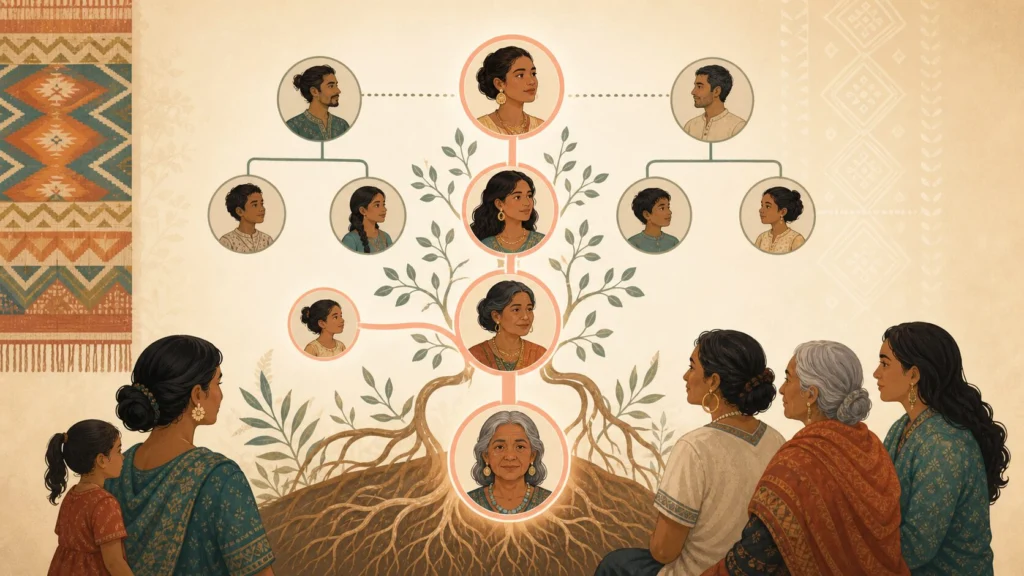
Illustration of a family tree highlighting maternal-line kinship across generations
Editor note: This article is a cultural and anthropology explainer. It avoids treating all matrilineal societies as identical and does not claim that matrilineality automatically means women hold all political power.
Who this guide is for: This article is for readers who want to understand maternal-line kinship, inheritance, clan identity, and the difference between matrilineality and matriarchy.
Editorial transparency: Prepared by The Infosiast and last reviewed on June 5, 2026. This article was rewritten to add nuance, examples, source links, and clearer definitions.
Matrilineality is a kinship system in which descent is traced through the mother’s line. In a matrilineal society, a person’s clan, lineage, inheritance rights, or social identity may be connected to maternal ancestors rather than paternal ancestors.
The key point is that matrilineality is about lineage. It does not automatically mean a society is ruled by women. That is a common misunderstanding. A society can trace descent through mothers while still having complex roles for men, elders, maternal uncles, mothers, sisters, and community councils.
Matrilineality vs. matriarchy
Matrilineality and matriarchy are not the same thing. Matrilineality describes how descent, clan membership, or inheritance is organized. Matriarchy usually refers to political or social authority held primarily by women. A matrilineal society may give women important social and economic roles, but authority can still be shared or held by men in certain institutions.
This distinction matters because oversimplifying the term can distort real cultures. Kinship systems are practical social structures, not slogans. The broader history of this approach is clearer in our guide to Auguste Comte, Émile Durkheim, and the foundations of sociology.
How maternal-line kinship works
In a matrilineal system, children may belong to the mother’s clan or lineage. Property, names, ritual roles, or social obligations may pass through women. In some communities, a mother’s brother can play an important role in the lives of children because he belongs to the same matrilineal line.
This does not mean fathers are absent or unimportant. It means the rules for belonging and inheritance are organized differently from patrilineal systems.
Examples of matrilineal societies
The Minangkabau of Indonesia are often discussed as one of the world’s largest matrilineal societies. In parts of West Africa, Akan kinship traditions are also commonly described in matrilineal terms. Other communities around the world have practiced maternal-line descent in different ways.
Examples should be handled carefully. No single society represents all matrilineal people. Local religion, colonial history, law, migration, economy, and modern education can all shape how matrilineal traditions work today.
Why matrilineality matters
- Inheritance: Property or rights may pass through the maternal line.
- Identity: Clan or family belonging may be defined through mothers.
- Social support: Maternal relatives may form a strong support network.
- Cultural memory: Stories, rituals, and obligations may preserve maternal ancestry.
- Gender roles: Matrilineal systems can challenge assumptions that descent must be paternal.
Modern change and adaptation
Matrilineal societies are not frozen in time. Urbanization, wage labor, state law, formal schooling, migration, and global media can all affect how kinship works. Some practices weaken. Others adapt. Some communities preserve matrilineal inheritance while changing marriage patterns or household arrangements.
This is why respectful discussion matters. Matrilineality should not be romanticized as perfect or dismissed as outdated. It should be studied as a living system that people negotiate across generations.
Common misconceptions
- Misconception: Matrilineal means men have no role. Reality: Men can have important roles, especially as brothers, uncles, fathers, leaders, or ritual participants.
- Misconception: Matrilineal societies are all the same. Reality: Practices vary widely.
- Misconception: Matrilineality is only historical. Reality: Some communities continue to preserve and adapt matrilineal traditions.
- Misconception: It is the exact opposite of patriarchy. Reality: Kinship, authority, property, and gender power can combine in complex ways.
What anthropologists look for
When researchers study matrilineality, they do not only ask who the mother is. They ask how descent is recorded, how inheritance works, where married couples live, who controls land or property, how children are affiliated with clans, and who has authority in disputes. These details can vary widely between communities.
For example, a society may trace clan identity through women but still assign ritual leadership to men. Another may pass property through women but expect maternal uncles to manage certain responsibilities. These patterns show why kinship terms need careful explanation.
Why the concept still matters today
Matrilineality helps readers question assumptions about family and inheritance. Many people grow up thinking paternal surnames, patrilineal descent, and father-to-son inheritance are natural or universal. They are not. Human societies have developed many ways to organize belonging, property, care, and authority.
Studying matrilineality can also help communities preserve cultural memory. When migration, urban work, schooling, or state law changes family life, people may still maintain maternal-line identity through rituals, oral history, names, land rights, or community organizations. The system may evolve, but it can remain meaningful.
Questions for respectful learning
- How does this community define descent and belonging?
- Who inherits property, titles, or ritual obligations?
- How do local people explain the system in their own words?
- How have modern law, religion, migration, or education changed the practice?
- What stereotypes should outsiders avoid?
Matrilineality in simple terms
If you remember only one idea, remember this: matrilineality follows the mother’s line for descent or belonging. It does not automatically decide every part of family life. Marriage, residence, leadership, inheritance, and ritual duties can each follow different rules depending on the community.
This is why the term is best used with context. Instead of saying a society is “run by women” or “the opposite of patriarchy,” it is more accurate to ask which rights and responsibilities pass through the maternal line and how people in that society explain those relationships themselves.
Related guides
Sources
Bottom line
Matrilineality is a way of organizing descent and belonging through the mother’s line. It can shape inheritance, identity, family obligations, and cultural memory. Understanding it requires nuance: matrilineal societies are diverse, adaptive, and more complex than the simple idea that they are just the reverse of patrilineal systems.