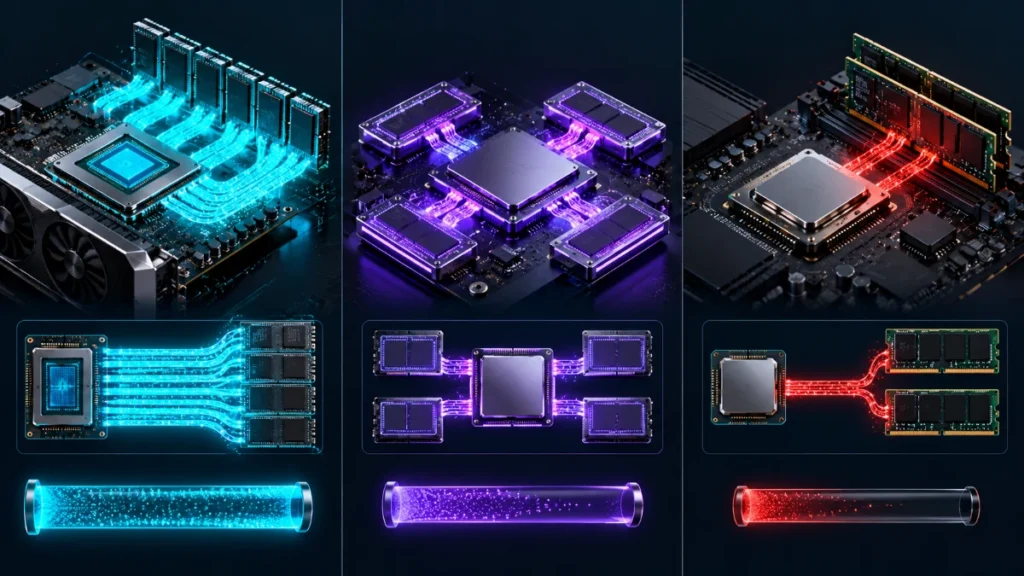
Technical architecture diagram comparing discrete GPU VRAM high-bandwidth data bus against Apple Silicon Unified Memory and system DDR5 RAM bottleneck
Choosing a local large language model that fits cleanly inside an 8GB, 12GB, or 16GB VRAM budget is the difference between responsive 45+ tokens-per-second generation and a single-layer PCIe spillover that drops throughput by 80%. While our Running Local LLMs on Consumer Hardware pillar covers the underlying memory formulas, this hands-on benchmark reference maps the exact models, quantization levels, and Ollama / llama.cpp launch flags for every mainstream consumer GPU tier in 2026.
Interactive Local LLM Hardware Tier & Ollama Configurator
Select your GPU VRAM (or Apple Silicon Unified Memory), primary workload, and target context length to generate the optimal model, GGUF quantization, and KV-cache launch command.
OLLAMA_FLASH_ATTENTION=1 OLLAMA_KV_CACHE_TYPE=q8_0 ollama run qwen2.5-coder:14b-instruct-q4_K_M
Why PCIe Spillover Destroys Local LLM Speed: VRAM vs. System RAM Bandwidth
A common question when configuring local models is: “Can a local LLM use system RAM if it exceeds my GPU VRAM?” While inference engines like llama.cpp and Ollama automatically offload overflow transformer layers to CPU system memory rather than crashing with an Out-Of-Memory (OOM) error, token generation is strictly memory-bandwidth bound. Every generated token requires reading every active model weight once:
Batch Size = 1 (Memory-Bandwidth Bound)
A mid-range desktop GPU with 360–504 GB/s of GDDR6X bandwidth reads a 9 GB 14B model 40–55 times per second. The moment 3 GB of weights spill over PCIe 4.0 into dual-channel DDR5 system RAM (~65–75 GB/s effective bandwidth), the CPU must compute those spilled layers at one-seventh the speed while waiting on GPU-to-host synchronization, dropping overall output from 45 tok/s down to 6–9 tok/s. Keeping 100% of weights and KV-cache inside physical VRAM is always faster than running a slightly larger parameter count partially in system RAM.
Tested 2026 Model Matrix Across 8GB, 12GB, 16GB, and 24GB VRAM
| GPU VRAM Tier | Top Coding & Agent Model | Top Reasoning / Math Model | Optimal GGUF Quant | Max Safe Context (100% GPU) |
|---|---|---|---|---|
| 8 GB VRAM (RTX 4060, RX 7600, M2 8GB) | Qwen2.5-Coder-7B-Instruct | DeepSeek-R1-Distill-Qwen-7B | Q4_K_M (4.7 GB) or Q5_K_M (5.4 GB) | 16,384 tokens (with q8_0 KV cache) |
| 12 GB VRAM (RTX 3060 12GB, RTX 4070 / Super) | Qwen2.5-Coder-14B-Instruct | DeepSeek-R1-Distill-Qwen-14B | Q4_K_M (8.9 GB) | 16,384 tokens (with q8_0 KV cache) |
| 16 GB VRAM (RTX 4060 Ti 16GB, RTX 4080, M4 16GB) | Qwen2.5-Coder-14B-Instruct (or Mistral-Small-24B) | DeepSeek-R1-Distill-Qwen-14B | Q5_K_M (10.5 GB) or Q6_K (12.1 GB) | 32,768 tokens (with q8_0 KV cache) |
| 24 GB VRAM (RTX 3090, RTX 4090, RX 7900 XTX) | Qwen2.5-Coder-32B-Instruct | DeepSeek-R1-Distill-Qwen-32B | Q4_K_M (19.5 GB) | 16,384 – 24,576 tokens (with q8_0/q4_0 KV) |
Enabling Flash Attention and Quantized KV-Cache in Ollama & llama.cpp
By default, many local inference servers allocate the key-value (KV) context cache in 16-bit floating point (FP16). On a 14B model at a 32,768-token context length, an uncompressed FP16 KV-cache consumes over 6.2 GB of extra VRAM—forcing layer offloading on a 16GB GPU. Enabling Flash Attention and 8-bit KV-cache quantization (q8_0) cuts KV memory in half with virtually zero measurable perplexity loss:
# Linux / macOS systemd or shell environment for Ollama
export OLLAMA_FLASH_ATTENTION=1
export OLLAMA_KV_CACHE_TYPE="q8_0"
export OLLAMA_HOST="127.0.0.1:11434"

# Equivalent direct llama.cpp server invocation with 100% GPU offload (-ngl 99)
./llama-server -m Qwen2.5-Coder-14B-Instruct-Q4_K_M.gguf
  -ngl 99 -c 16384 -fa --cache-type-k q8_0 --cache-type-v q8_0
  --host 127.0.0.1 --port 8080
For architectural details on how DeepSeek R1 compresses KV-cache natively using Multi-Head Latent Attention (MLA), see our DeepSeek R1 Architecture & Deployment Guide, or calculate exact custom parameter footprints in our 2026 Local LLM VRAM Calculator.
Written and prepared by Kshitij Gupta.