Editor note: This article explains archaeological and microbiome research for general readers. It is not dental or medical advice.
Who this guide is for: Students, history readers, science learners, and anyone curious about how tiny traces on teeth can preserve human stories.
Editorial transparency: Prepared by The Infosiast and last reviewed on June 5, 2026. This article was rewritten to add clearer scientific context and source links.
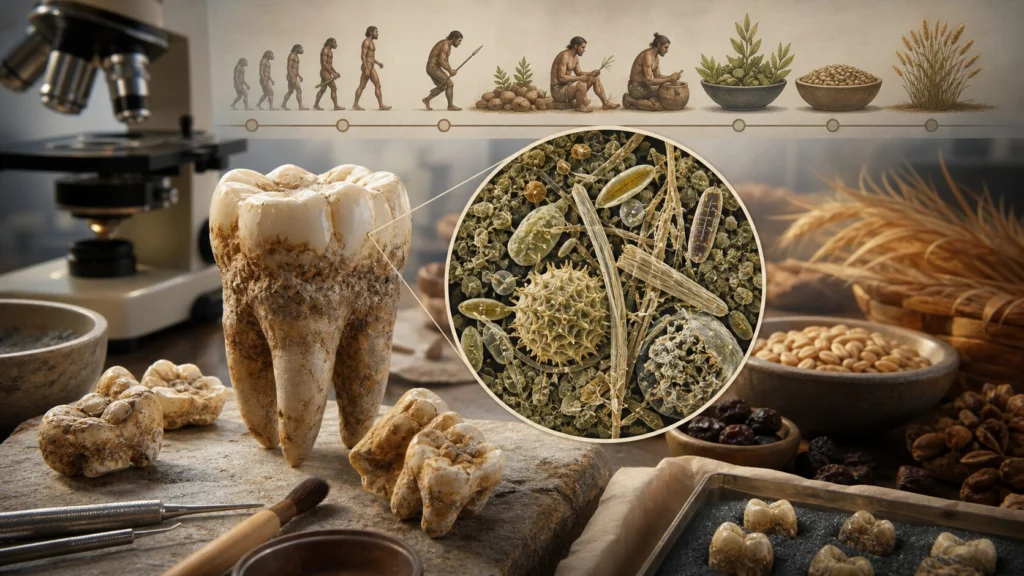
Ancient teeth can act like small archives. They preserve wear marks, cavities, chemical signatures, and sometimes calcified dental plaque known as dental calculus. That calculus can trap DNA, proteins, starch grains, plant particles, and microbial evidence. For archaeologists, it can reveal what people ate, how diets changed, and how the human oral microbiome shifted over time.
This matters because written records cover only a small part of human history. Teeth can speak for people who left no books, recipes, or medical records. They can help researchers understand farming, migration, disease, industrial diets, and the relationship between culture and biology.
What is dental calculus?
Dental plaque is a sticky biofilm that forms on teeth. If it mineralizes, it can become hardened dental calculus. Modern dentistry removes calculus because it can contribute to oral health problems. In archaeology, however, ancient calculus can preserve valuable evidence because it can remain attached to teeth for centuries or even millennia.
Researchers can analyze calculus using DNA sequencing, microscopy, protein analysis, and chemical techniques. Each method reveals a different kind of clue.
What can it reveal?
- Diet: Starch grains, plant remains, and proteins can suggest foods people consumed.
- Microbes: Ancient oral bacteria can show how mouth ecosystems changed.
- Disease patterns: Some microbial shifts may connect with tooth decay or gum disease.
- Lifestyle transitions: Farming, processed foods, and sugar can leave biological traces.
- Population history: DNA and microbial patterns can sometimes connect with migration and contact.
Diet changed the mouth
One major theme in ancient dental research is dietary transition. The shift from foraging to farming introduced more carbohydrate-rich foods in many populations. Later, industrial diets brought processed flour and sugar into daily life on a much larger scale. Research on ancient calculus and oral microbiota suggests these changes affected the ecosystem of the mouth.
That does not mean every ancient person had perfect teeth or every modern problem has one simple cause. Oral health depends on diet, hygiene, genetics, environment, access to care, and cultural habits. But teeth do preserve evidence that diet and disease patterns changed across human history.
Why dental calculus is useful
Food remains do not always survive in archaeological sites. A meal may disappear, but microscopic traces can remain in calculus. That makes dental calculus especially useful for studying ordinary life: what people ate, what plants they used, whether they consumed dairy, and how their oral microbes adapted.
Calculus is also personal. A storage pit can show what a community used, but calculus is attached to an individual. That can help researchers compare diet by age, sex, status, occupation, or region when enough samples are available.
What researchers must be careful about
Ancient DNA and microfossil research is powerful, but contamination is always a concern. Samples can be affected by soil, handling, modern DNA, preservation conditions, and laboratory methods. Good studies use controls, careful extraction, and cautious interpretation.
Another caution is that dental evidence is not a full menu. It can show traces, patterns, and probabilities, but it may not capture every food a person ate. Researchers combine dental evidence with bones, tools, settlement data, written records, isotopes, and environmental evidence.
Why this research feels personal
Teeth connect big history to everyday life. Farming was not just an economic shift; it changed meals, work, disease, settlement, and bodies. Industrial food was not just a business change; it altered sugar exposure, processing, and oral-health patterns. Ancient dental plaque lets scientists study those changes at a human scale.
It also reminds us that the human body is not separate from culture. What people grow, trade, cook, and value can shape biology over generations.
Related guides
Sources
- Nature Genetics: Sequencing ancient calcified dental plaque
- PMC full text: Ancient calcified dental plaque and dietary shifts
- Microorganisms: Ancient dental calculus and oral microbiome review
- British Dental Journal: Dental analysis and archaeology
From ancient plaque to modern questions
Ancient dental calculus also helps modern readers think differently about oral health. It shows that the mouth is an ecosystem, not just a place where teeth sit. Microbes, diet, saliva, hygiene, and environment interact. When diets changed, the mouth’s microbial community could change too.
This does not mean ancient people had one uniform oral-health pattern. Hunter-gatherers, farmers, pastoralists, city dwellers, sailors, elites, and laborers could have very different diets and dental outcomes. Geography, food processing, cooking tools, water, medicine, and social status all mattered.
Why interdisciplinary work matters
Dental-plaque research sits between archaeology, genetics, microbiology, chemistry, anthropology, and dentistry. A microscope image alone cannot tell the whole story. Neither can DNA alone. Strong interpretations usually combine several lines of evidence: tooth wear, calculus, isotopes, bones, tools, settlement remains, climate data, and historical records where available.
That is what makes the field exciting. A tiny sample from a tooth can connect to questions about farming, migration, trade, disease, cooking, childhood, and the daily routines of people who lived long before modern records.
What this teaches about everyday history
Dental calculus research is powerful because it brings everyday history into view. Kings, wars, and monuments often dominate history books, but most human life was built from ordinary routines: grinding grain, cooking plants, caring for children, sharing food, migrating, farming, trading, and adapting to local environments. Teeth can preserve traces of those routines.
That makes the evidence emotionally interesting as well as scientific. A small mineralized layer on a tooth can show that ancient people were not abstract figures in a timeline. They were eaters, workers, families, experimenters, and communities whose daily choices left biological records behind.
Bottom line
Ancient dental plaque is more than old tartar. It can preserve traces of diet, microbes, and daily life. By studying it carefully, researchers can connect human history with food, health, migration, and the changing relationship between culture and biology.
Why dental calculus matters to archaeology
Dental calculus is mineralized plaque. In archaeology, it can preserve traces of microbes, proteins, and dietary particles that help researchers study past diets, oral health, and microbiomes. The evidence is powerful, but it still needs careful lab interpretation because preservation, contamination, and sample context can change what researchers can conclude.
For deeper source context, see research on proteomic evidence of dietary sources in ancient dental calculus and Max Planck’s summary of how protein analysis can retrieve dietary information from ancient dental calculus. Related Infosiast reading: Indus Valley Civilization and the Science & Learning hub.