
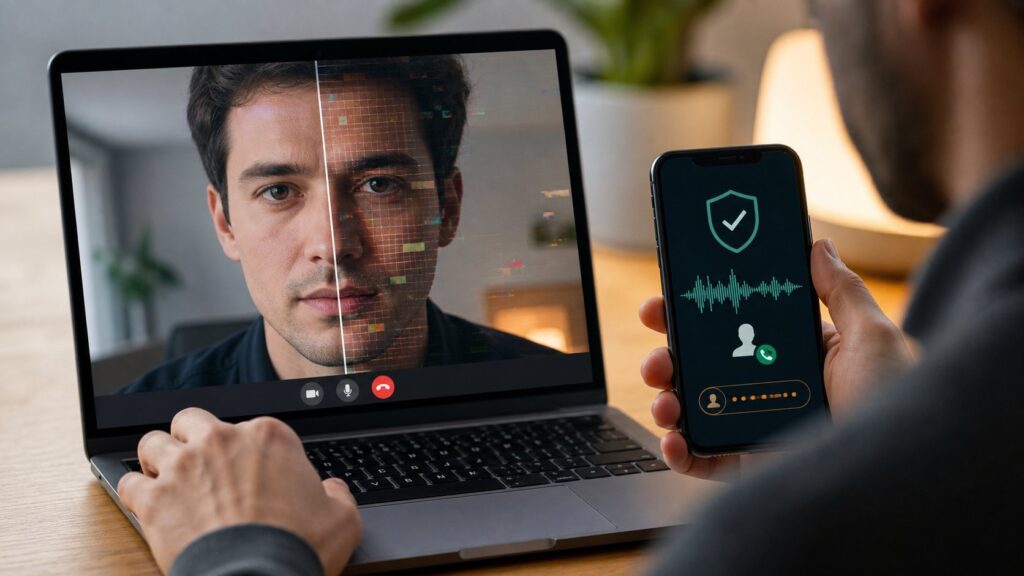
When a voice, video or image is used to demand money, access or sensitive information, verify the request through an independent channel before acting. You do not need to prove that a recording is a deepfake to refuse an unsafe request.
Deepfake scams use generated or manipulated media to support impersonation. The most useful response combines source checking, normal approval procedures and careful handling of payments or credentials. This guide explains those steps and the limits of visual clues and Content Credentials.
How an impersonation request reaches you
A synthetic voice can make an emergency story sound familiar. The FTC describes family-emergency scams in which a caller imitates a loved one and presses for money. It recommends contacting the person using a number already known to you instead of trusting the voice alone. FTC guidance on voice-cloned emergency scams.
Other requests can claim to come from a colleague, official, investment promoter or online acquaintance. Whether the media is synthetic or simply misleading, treat an unexpected demand for a transfer, sign-in code or confidential file as a request that needs verification.
Check the request, not just the recording
| Scenario | Useful check | Unsafe shortcut |
|---|---|---|
| Family emergency | Contact the person or another trusted contact using established details | Calling only the number supplied by the caller |
| Workplace payment | Follow the normal approval and recipient-verification process | Bypassing approvals because a video looks convincing |
| Investment endorsement | Check the offer and operator independently | Treating a familiar face as proof of a legitimate investment |
| Account-security warning | Open the service independently and inspect its alerts | Sharing a verification code with the person making the claim |
Urgency, secrecy, a new payment destination or pressure to skip an established process should slow your decision. These clues do not prove a deepfake; they identify a request that has not earned trust. A normal-sounding call can still contain a fraudulent request.
Use an independent verification process
- Pause: do not transfer money, share credentials or open an unexpected attachment while the caller pressures you.
- Choose the destination yourself: use a contact detail or service you trusted before the message arrived.
- Verify the actual instruction: ask whether the person made the request and confirm the recipient, amount or document involved.
- Keep normal approvals: a claimed emergency does not authorize bypassing a workplace payment or access-control process.
- Escalate uncertainty: if you cannot verify, involve an appropriate trusted person or your organization’s established support team.
A family verification phrase can be an additional check, but should not be the only one. Keep it private, and do not publish examples containing your real answers. A voice, face or secret that has already been exposed cannot serve as reliable proof on its own.
What Content Credentials can tell you
C2PA Content Credentials record provenance using cryptographically signed, tamper-evident structures associated with an asset. Provenance can supply information about the file’s recorded origin and changes. The C2PA explainer explicitly separates validation of that information from judging whether the depicted content is true. C2PA architecture and limits.
A credential is therefore one piece of context, not authorization to pay someone or a guarantee that an event happened. Inspect what it actually asserts and which signer is trusted. The C2PA FAQ explains the standard and trust mechanisms in more detail.
Do not turn an absent credential into a verdict that a file is fake. Nor should a visible icon replace verification of the person and transaction. Media provenance and identity or payment approval answer different questions.
How to use detection clues cautiously
Unusual lip movement, audio pacing or a strange background may justify closer inspection. They are not a dependable pass-or-fail test: ordinary compression, connection problems and editing can also make media look unusual.
If you use a detection tool, read its intended use and limitations. Record the tool, version, input and result. Treat the output as an assessment requiring context rather than a final accusation. Avoid uploading private voice recordings, identity documents or intimate material to an unfamiliar service.
Detection accuracy must be assessed for a particular tool, input type and evaluation method. Results from one dataset should not be treated as a guarantee about a recording received in a real conversation.
If money or account access was already shared
Contact the affected bank, payment service or account provider promptly through its established channel. Describe the transaction or access involved and ask what protection or recovery options are available. Outcomes depend on the provider and circumstances; a request to recall a payment is not a promise of recovery.
If a password or session was exposed, follow the service’s account-recovery guidance and review access and recovery settings. Our OTP scam guide covers verification-code risks. For deposit-based messaging jobs, see our task-scam guide.
Preserve the original message, relevant timestamps, account identifiers, receipts and incident references privately. Report through the platform and appropriate authorities in your location. Reporting routes and legal obligations vary; this guide does not present one country’s helpline or deadline as a universal procedure.
A verification worksheet for families and teams
- Who is authorized to request money, access or confidential information?
- Which established contact route will you use to verify?
- Who gives a second approval when the request is unusual?
- What recipient details must be checked independently?
- Where will incident evidence be stored privately?
- Who is the verified support contact if information has already been shared?
Glossary
- Deepfake: synthetic or manipulated media used to represent a person or event.
- Provenance: information about content’s recorded origin and history.
- Independent channel: a contact route chosen separately from the suspicious request.
- Impersonation: falsely presenting oneself as another person or organization.
Sources and editorial review
Updated 1 October 2026. This guide draws on the linked FTC warning and C2PA documentation. The verification worksheet is practical editorial guidance; no forensic examination or detection-tool test is claimed. Send corrections through our contact page.
Written and prepared by Kshitij Gupta.
The Engineering Reality Behind 2026 Deepfake Scams
By 2026, the defensive question has shifted from “can I spot a fake?” to “how fast can a synthetic puppet move, and where does its physics break?” Answering that requires understanding the full pipeline of a modern real-time voice clone and face swap at the systems level — because every component in that pipeline imposes latency budgets, occlusion failures, and spectral fingerprints that a well-designed verification protocol can exploit. This section documents those pipelines, the mathematics governing them, and the deterministic out-of-band (OOB) architectures that neutralize them.
1. Anatomy of Real-Time Zero-Shot Voice Cloning
A 2026-generation zero-shot speech synthesizer requires no speaker-specific training pass. It operates as a conditional generative model in one of two dominant architectures:
- Codec language models. The input reference waveform is encoded by a neural codec (e.g., RVQ-based codecs operating at 25–75 ms frame rates) into discrete audio tokens. An autoregressive transformer predicts target tokens conditioned on (a) the semantic content tokens extracted from a text or phoneme sequence, and (b) timbre/prosody tokens from the reference utterance. A second stage — either another AR pass or a non-autoregressive diffusion/score decoder — converts predicted tokens back to PCM.
- Flow-matching vocoders with global style vectors. A speaker-embedding encoder condenses the 3–10 second reference clip into a fixed-dimensional style vector (typically 128–256 dims). A text-to-spectrogram generator conditions on it, and a flow-matching (rectified-flow) vocoder renders the waveform in few steps — often 4–16 function evaluations — which is why this class dominates low-latency deployments.
The attack-relevant property is the reference economy: roughly 3 seconds of clean speech is sufficient for convincing timbre; 8–10 seconds materially improves prosodic fidelity, pause placement, and emotional register. That quantity is trivially harvestable from voicemail greetings, webinar recordings, conference-panel Q&A, podcast appearances, or a short social-media video. Once cloned, streaming inference adds per-chunk latency: typical end-to-end figures break down as approximately 80–120 ms of codec/encoder lookahead, 60–150 ms of model compute per chunk on consumer GPUs, and 40–90 ms of jitter-buffer accommodation — comfortably inside a <300 ms conversational budget that feels “live” to a victim. Frame-level prosody matching also means pitch-contour plots, long the staple of amateur forensics, no longer separate real from synthetic with any reliability.
Failure modes an attacker still inherits:
- Reference contamination. If the scraped reference was recorded in a reverberant room or over a compressed telephony channel, those channel artifacts (room tone, bandwidth limits above ~4 kHz, codec warble) imprint onto every synthesized utterance. The clone may carry its source’s acoustic fingerprint into a call claiming to originate elsewhere.
- RNR boundary discontinuities. Streaming chunks stitched by overlap-add produce micro-discontinuities at frame boundaries detectable via spectral-flux analysis — transient energy spikes between frames that natural phonation never exhibits.
- Emotional register mismatch under stress. Extortion scripts demand arousal levels absent from calm references; zero-shot emotional extrapolation frequently overshoots or produces flat-affect speech wearing exaggerated words.
2. Anatomy of Live Video Face-Swap and Head-Reenactment Pipelines
The video side of a live executive impersonation is typically a three-stage chain riding on OBS VirtualCam or an equivalent loopback device driver:
- Identity encoding. A face-recognition backbone maps the attacker’s live face (or a target photo) to an identity embedding; a source video/photo of the victim supplies the victim embedding.
- Latent-space manipulation. A generator (GAN-based for sub-30 ms systems, diffusion or flow models for higher fidelity) performs in-place latent editing of mouth region, jawline, and expression — increasingly the full head via neural reenactment driven by the attacker’s facial landmark stream.
- Temporal smoothing. Recurrent keypoint filters suppress inter-frame jitter; this smoothing is what makes single-frame “glitch hunting” nearly useless against 2026 models but also introduces up to 150–200 ms of visual lag behind audio — one measurable seam.
The entire stack runs at 15–45 fps on a single consumer GPU, which is why Zoom/Teams meetings with executives demanding urgent wire transfers have become viable. Crucially, passive detection heuristics (“look for blinking problems,” “check the hairline”) were calibrated on pre-diffusion artifacts that no longer exist. Diffusion and codec generators produce photometrically plausible skin, correct blink dynamics, and consistent lighting because they are conditioned on the real camera feed rather than hallucinating from scratch.
3. Where Physics Still Betsrays the Puppet
Detection in 2026 is not about texture; it is about physical constraints that generative pipelines do not model or cannot satisfy within their latency budget:
| Physical boundary | Why models fail it | Practical probe |
|---|---|---|
| Head-turn occlusion (≥60–90° yaw) | Reference data is frontal/±30°; extreme yaw forces the generator to hallucinate ear geometry and hair volume it never saw. | Ask them to turn fully sideways as if reacting to someone off-camera; watch for smearing, identity flicker, or a frozen head with faked nodding. |
| Specular corneal reflection | Eye highlights must mirror the true scene’s light sources in position, shape, and intensity. Generators approximate but rarely keep both eyes geometrically consistent with an unseen environment. | Move your own light source (phone flashlight near camera) — genuine reflections shift instantly and symmetrically with correct parallax. |
| Structured-light occlusion transients | A real hand waved between face and light produces dynamic cast shadows whose edges track the 3D geometry of skin. Re-rendered faces lag or blur shadow boundaries. | “Wave your hand in front of your face.” Real-time swaps frequently drop frames or smear exactly at the occlusion event. |
| Acoustic room-impulse response (RIR) | Synthesized audio carries the RIR of the reference clip, not the claimed environment. A “boardroom call” sounding like a closet-sized phone recording is a physical contradiction. | Ask them to tap the desk or knock on wood — transients expose the true channel’s reverb tail and spectral coloration instantly. |
Each probe exploits the same principle: force interaction with unmodeled physics inside a sub-second decision window. A puppet operator juggling GPU latency, audio ducking, and improvisational dialogue will fail one of these eventually — but only if you ask. No passive inspection substitutes for an active physical challenge.
4. Deterministic Out-of-Band Verification Protocols
The engineering conclusion is that probabilistic detection is a losing arms race. Deterministic verification — protocols whose security does not depend on your ability to judge pixels — is the correct control. Three layers follow.
Layer 1: Pre-Shared Rotating Codewords (Personal/Family)
Family-emergency extortion (the “kidnapped relative” voice clone) collapses against a single shared secret established in person during calm times:
- A duress codeword: a contextually plausible phrase never used otherwise (“Did you feed Biscuit today?” means “I’m coerced”).
- A safety question with an answer unknowable from social media — not a pet’s name or birthplace, which scrapers own.
- Rotation policy: change the codeword quarterly or after any suspected leak; treat it like a password because functionally it is one.
- Call-back rule: hang up and dial the claimed caller on a number stored independently (saved contact, written card). Voice identical ≠ identity proven; the clone cannot originate inbound calls from the real handset.
Entropy matters: choose a two-word nonce pair rather than a memorable sentence pattern — scraped text corpora make fluent phrases guessable, arbitrary word pairs do not.
Layer 2: Enterprise Dual-Custody with FIDO2 Hardware Keys
For wire transfers, payroll changes, and vendor-bank-detail updates, human judgment must be removed from the critical path. A reference protocol:
# Policy sketch (pseudo-config for a treasury approval workflow)
# Requires TWO independent approvals via separate FIDO2 hardware keys,
# out-of-band channel separation, and an amount-threshold trigger.

policy "wire-change-dual-custody" {
  trigger_amount_gt      = 0            # ANY beneficiary bank detail change
  approvers_required     = 2
  approver_set           = ["cfo", "treasury-lead"]
  same_person_forbidden  = true         # custody separation enforced
  authenticator_class    = "fido2-hardware"   # platform passkeys disallowed:
                                              # synced passkeys share cloud
                                              # trust domain with email,
                                              # the phishable channel
  oob_channel            = "voice-call-preknown-number"
                                        # NOT reply-to-thread; NOT number
                                        # shown on caller ID of request
  challenge_content      = "beneficiary+amount+currency+deadline"
  max_validity_minutes   = 30           # urgency weaponized by attackers;
                                        # expiry caps pressure window
}

# Verification ritual on any 'urgent CFO video call' requesting transfer:
# 1. Requester reads nothing; approver dials back from directory.
# 2. Approver reads challenge content aloud; requester confirms via
#    codeword, THEN approves on hardware key (user presence + PIN).
# 3. Second custodian repeats independently. Single approval = rejected.
The FIDO2 requirement is not ceremony: WebAuthn assertions are origin-bound and phishing-resistant, so a deepfake call cannot produce one — the attacker would need physical possession of two separate hardware tokens held by two people. The voice call adds a biometric-agnostic human factor; the combination makes the scam’s cost model collapse from minutes of GPU time to a multi-party physical compromise.
Layer 3: C2PA Content Credentials
The Coalition for Content Provenance and Authenticity (C2PA) standard cryptographically binds media to its capture or authoring history: each manipulation appends a signed claim describing what was done and by which tool, forming an auditable manifest embedded in the file. Signatures use Ed25519 or ECDSA over a JUMF (JSON Universal Manifest Format) structure anchored to the original bytes via a hash tree.
- Enterprise-grade practice: executives who publish video messages sign them at creation with a hardware-backed key registered to the organization’s certificate chain. Recipients of any subsequent “CEO video instruction” verify the manifest: unsigned or broken-chain media fails closed.
- Verification (conceptual CLI):
# Validate a provenance manifest shipped inside a media asset
c2patool verify ceo_announcement_q3.mp4 --trust-chain org-ca.pem

# Output summary fields that matter:
#   signature_alg      : Ed25519 | ES256/ECDSA-P256
#   signer_cert_valid  : true (chains to org trust anchor)
#   ingredient_hashes  : all source clips verified intact
#   actions[]          : 'created' -> no synthetic-generation claims
Caveats to state honestly: C2PA proves provenance, not truth — a signed deepfake is an authentic record of a fake. Its value depends on the trust anchors being real, and stripped-metadata re-encodes destroy manifests (hence verify before relying). Still, for high-value internal channels it converts “is this real?” into a deterministic signature check.
5. Empirical Comparison of Defense Layers
| Control | Attack surface covered | Attacker cost increase | Failure mode |
|---|---|---|---|
| Passive visual/audio inspection | Pre-2024 artifacts only | ~0× in 2026 | Diffusion models produce no persistent texture tells; human accuracy approaches chance under time pressure. |
| Active physical probes (yaw, hand-wave, corneal) | Live video puppets | High — forces GPU/latency tradeoffs and improvisation | Skilled operators pre-rig probe responses; works best combined with OOB rules. |
| Call-back to independent number | Voice-clone calls, extortion | Very high — requires SIM/control of real endpoint | Victims dial the number shown on caller ID instead of a stored one — training dependency. |
| Rotating duress codewords | Family emergency, coercion claims | Near-total for opportunistic attackers | Stale codewords; answers scraped from social profiles. |
| FIDO2 dual-custody treasury approval | Wire fraud, BEC-deepfake hybrids | Requires physical multi-party compromise | Policy bypass under “CEO exception”; synced passkeys weakening the trust domain. |
| C2PA signed executive media | Video/audio instruction fraud | Requires key theft to forge | Unsigned legacy content; recipients skip verification. |
6. A Minimal Incident Playbook (Detection to Recovery)
- T+0 minutes: Freeze all pending transfers via the treasury system’s hold function — not by messaging the person who made the request, whose channel is presumed compromised.
- Notify through the second channel: contact the bank’s fraud desk on independently stored numbers; interbank recall windows are measured in hours, and success rates decay steeply after the funds move through intermediary accounts (mule chains commonly fragment amounts across 5–15 endpoints within the first day).
- Preserve evidence: export call logs, meeting recordings, message threads, and any media files with metadata intact before re-encoding anything.
- Rotate secrets: duress codewords, approver sets, and any credential the impersonation touched.
- Post-mortem the boundary: identify which deterministic control was absent or bypassed; patch policy, not just the incident. Legal reporting obligations differ by jurisdiction — treat local regulators and helplines as regional specifics, never as a universal checklist.
The strategic takeaway: generative audio and video have crossed the threshold where perception is no longer authentication. Budget your defense accordingly — spend on protocol determinism (independent channels, hardware signatures, custody separation) rather than on chasing detector accuracy against models that regenerate faster than detectors can fingerprint them. Every percentage point of detection precision is rented; every FIDO2 assertion enforced is owned.
Written and prepared by Kshitij Gupta.